
A structured, forensic analysis of high-stakes performance failures
For exams, interviews, pitches, presentations, and competitions
Trusted by high-performing students, founders, and professionals after
high-stakes failures.
Intake required · Sessions by invitation only
A Performance Autopsy is a 60–75 minute, structured post-mortem that examines:
This isn't coaching, therapy, or motivation.
It's failure analysis.
After a disappointing exam or interview
After a failed pitch, demo, or launch
After an unexpectedly weak performance
If you know "something went wrong" but can't explain what, this is for you.
This is not designed for casual coaching, ongoing therapy, or motivational support.
Understand what went wrong
Know how to fix it
Actionable next steps
Download a sample post-mortem report to see what you'll receive
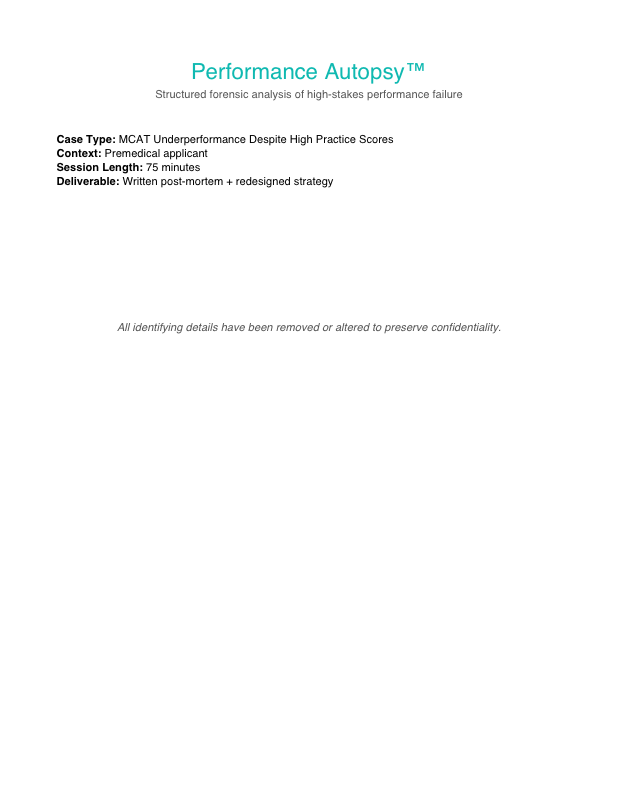
This anonymized sample demonstrates the depth and structure of a complete Performance Autopsy analysis:
Anonymized example for demonstration purposes
Every session follows a fixed analytic sequence so nothing important is missed:
Detailed timeline of what happened, moment by moment
Identify where mental resources were overwhelmed or misallocated
Pinpoint the specific breakdowns in thinking and execution
Example: time blindness, narrative collapse, over-rehearsal rigidity
Uncover gaps in preparation, sleep, framing, and information flow
Build concrete systems to prevent the same failures
This framework focuses on structure, not blame.
Real results from real sessions
Testimonials shared with permission. Some identifying details
withheld for confidentiality.
"The session completely changed how I approach high-pressure exams. I finally understood where my studying was falling short."
"I bombed my end-of-semester presentation and couldn't figure out why. This autopsy pinpointed exactly where my cognitive processes failed. Really helpful."
"Not your typical coaching. This analysis left me with actionable strategies to prevent my mistakes from recurring."
"After falling behind in my tournaments, I was devastated. This autopsy helped me identify my exact failure points and rebuild my preparation system from scratch."
"The structured approach was exactly what I needed. No fluff, just direct analysis of where my performance screwed up and how to fix it."
"Best investment I made after a failed interview. The written report alone was clear and thorough and I still reference it before big moments."
"I was skeptical at first, but the depth of analysis was really great. They found patterns in my planning failures that I wouldn't have seen on my own."
Anonymized examples from real Performance Autopsies
Premed student averaging 516–518 on full-length practice exams scored significantly below expectation on test day, primarily in CARS and B/B.
Student initially attributed the drop to "test-day nerves" and fatigue.
Core issue: decision density mismatch - test-day conditions introduced more real-time judgment calls than practice environment trained for.
Test-execution model designed for stress robustness rather than score chasing.
High school applicant with near-perfect GPA rejected post-interview from BS/MD program.
Believed responses were clear but didn't "stand out."
Loss of narrative control under adaptive questioning.
Understanding of why strong prep collapsed and how to rebuild strategy.
Top-of-class student scored significantly below average despite full content mastery.
"Panicked" after realizing early answers were incorrect.
Absence of cognitive compartmentalization under evaluative pressure.
Preserved performance even after inevitable early errors.
College sophomore rejected despite strong research exposure.
Answers were "too detailed" and time management was off.
Misalignment between explanation depth and listener decision model.
Tools to communicate expertise economically.
Inconsistent performance across CASPer scenarios - answers "ethical but rushed."
Speed was believed to be the primary limitation.
Ethical narration overload, not values or empathy.
Response system built for consistency under extreme time pressure.
(intro pricing)
Rising as capacity fills
Optional follow-up rebuild sessions available if needed.
We analyze failure, because that's where leverage lives.
5 minutes
Within 24 hours
If appropriate
All sessions are confidential and client-controlled.
No, not at all. While AI is used to isolate reasons for failure, our team composed of consistent high-scorers and 99th percentile students carefully review and analyze your performance. AI is not a replacement for human analysis.
Coaching optimizes what's working. Performance Autopsy forensically analyzes what failed. We don't motivate or set goals: we deliberately reconstruct failure to redesign cognitive systems and prevent recurrence.
Most failures feel vague (You might think, "I just choked" or "my mind went blank"). That's exactly what we analyze. Vague feelings have precise causes, and it's our job to find them.
People who understand how to succeed but underperformed in a high-stakes moment. If preparation wasn't the issue, but execution was, this is for you.
No. We guarantee a structured analysis and concrete recommendations. Implementation and future performance are up to you.
Yes, indirectly. The autopsy identifies what broke down, and we provide a redesigned preparation framework. Optional follow-up sessions are available for implementation support.